Binance Beginner Mistakes: 5 Checks Before Moving Funds
A practical safety checklist for new Binance users: verify messages, protect account access, match transfer details, include required memos, and understand leverage.
Before your first transfer or trade on Binance, check five things: the route you used to reach the service, account security, the asset and network, any required memo, and the risk of the product. These checks address different failures. A correct password cannot fix a wrong transfer network, and a cheaper fee cannot make an unsuitable trade safe.
1. Let a verified entry point guide your next click
An unexpected message may claim that you must log in urgently, recover funds, or verify your wallet. Open the service independently through a bookmark you have verified or the official app, then check the account itself. Do not use a stranger's recovery link or give them remote control of your device.
Binance's anti-phishing code is one way to help assess messages. The official guide describes the website route as Account → Security → Advanced Security → Anti-Phishing Code. Follow the on-screen setup and security verification; the app uses a different route. A missing or incorrect code is a warning sign, but a correct-looking message is not a reason to disclose credentials or trust every link.
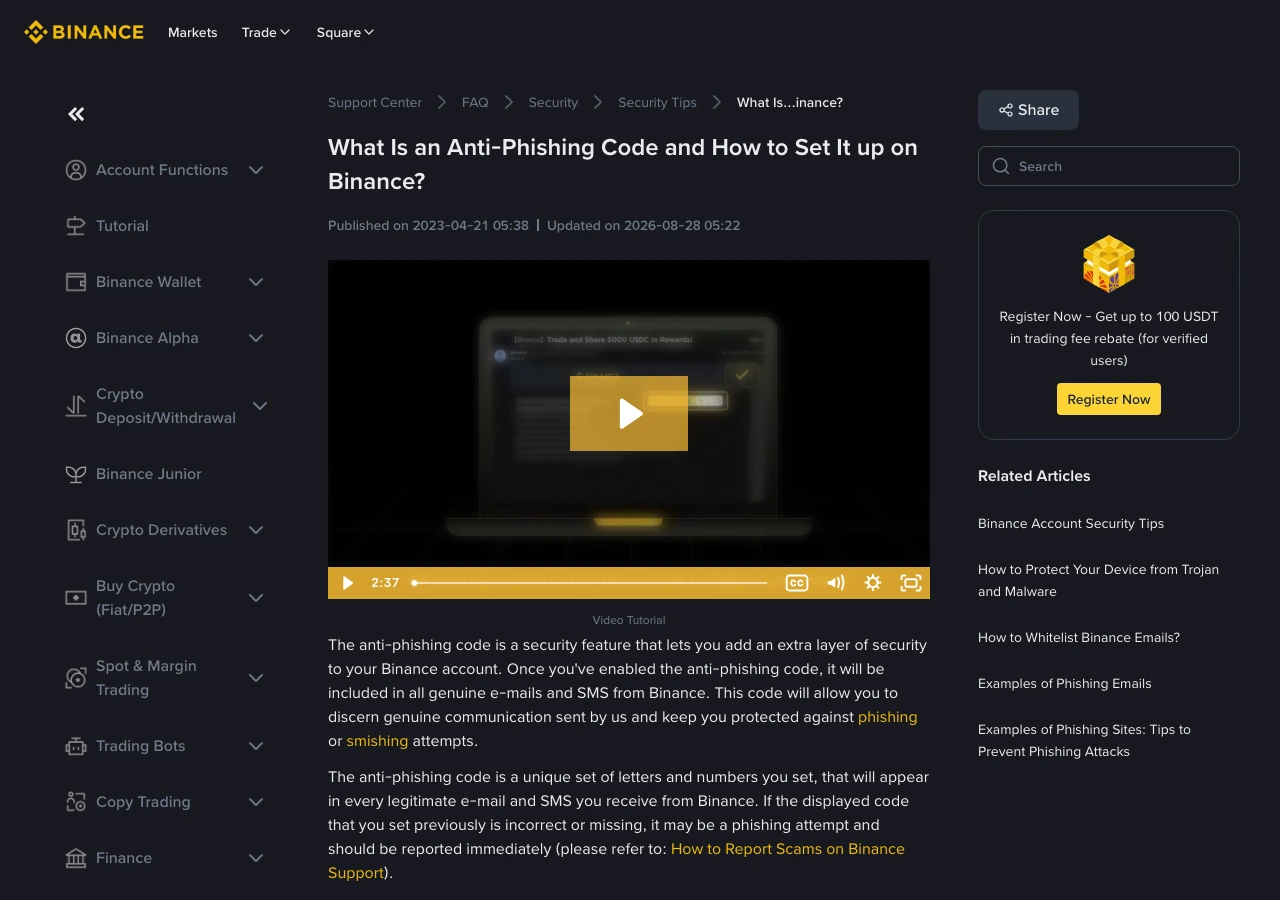
This is a screenshot of the official help article, not your security settings. The promotional sidebar belongs to that source and is not an offer from Coivio.
2. Secure access before funding the account
Use a unique password and an additional authentication method available to you. Keep recovery information private and protect the email account connected to Binance. Check the authorized-device list after replacing or losing a device, and investigate unfamiliar access.
The official account security guide explains authentication, device management, and related controls. Treat the email account as part of the same security setup: someone who can access it may also be able to receive recovery messages.
Do not send passwords, one-time codes, recovery keys, or wallet recovery phrases to an inviter, support account in a direct message, or this website. Account security reduces specific access risks; it does not remove the risks of the asset or the exchange.
3. Match the asset, network, and receiving address
Start from the receiving account's current deposit instructions. Compare them against the sending screen before confirming anything. A matching token name is not enough, and a familiar-looking address does not prove that the selected networks match.
Use this checklist for a new route:
| Item | What to compare | Stop if |
|---|---|---|
| Asset | The asset selected by the sender and receiver | The name or supported asset is unclear |
| Network | The sending network and the receiving account's supported network | They do not match, or support is uncertain |
| Address | The current address provided by the receiver and the pasted destination | They differ |
| Minimum | The receiving minimum and the amount expected to arrive | The amount would be below the minimum |
| Extra identifier | Any memo, tag, or payment ID required by the receiver | A required value is missing |
The official deposit and withdrawal guide explains the transfer process and network checks. Choosing a network solely because its fee is lower can cause loss if it is incompatible.
For an unfamiliar route, consider a small test that still meets the receiving minimum after applicable deductions. Wait for it to arrive before deciding whether to send more. A test is an additional check, not permission to ignore the current instructions on a later transfer.
4. Include the memo or tag when the receiver requires it
Some receiving accounts need an extra identifier to assign a deposit correctly. Copy the value shown by the receiving service alongside the address. Do not invent a memo or copy one from an unrelated tutorial.
If a transfer does not arrive, save its transaction ID, asset, network, amount, and destination details for official support. The incorrect-deposit FAQ describes different recovery situations and states that recovery is not guaranteed. Do not pay an unsolicited “recovery expert” on the assumption that a blockchain transfer can be reversed.
5. Understand leverage before considering it
A leveraged position can be closed automatically when its margin becomes insufficient. Higher leverage can make an adverse price move more damaging. The official liquidation explanation describes the mechanism.
Before considering such a product, be able to explain its margin requirement, liquidation risk, and costs in your own words. If you cannot, opening the position to learn how it works puts money at risk before you understand the rules. A voucher or referral rebate does not offset that uncertainty.
A final check before you confirm
Read the confirmation screen without rushing. Verify the destination details against the receiving account, review the total amount and charges, and stop if an unexpected prompt appears. If someone is pressuring you to act, resolve the uncertainty through official support instead of allowing the deadline to decide for you.
For account setup, read the personal registration checklist. For costs and promotions, read fees and referral rebates explained.
Sources and editorial note
Official public guidance reviewed on 17 September 2026. The checklist combines the cited instructions into a sequence a beginner can review; it does not describe a transfer personally performed by the author.
- Anti-phishing code guide
- Account security guide
- Deposit and withdrawal guide
- Incorrect-deposit FAQ
- Forced liquidation
Coivio is independent and is not affiliated with or endorsed by Binance. This article contains no referral invitation. Send corrections to coivio@coivio.com without account credentials or private financial information. Educational information, not individualized financial advice.